
Resources
Blog
- By Sean Moth
- Friday, 13 February 2026
- Applications: Water
The Perfect Match: Why HDPE Is Built for Rural Water Systems
Valentine’s Day usually finds you with that certain someone or seeking them.
Hopefully not both.
In the world of piping solutions, high-density polyethylene (HDPE) is known for its compatibility across countless applications.
But, when it comes to rural water systems, there is something about HDPE that sinks cupids’ arrow into the perfect target.
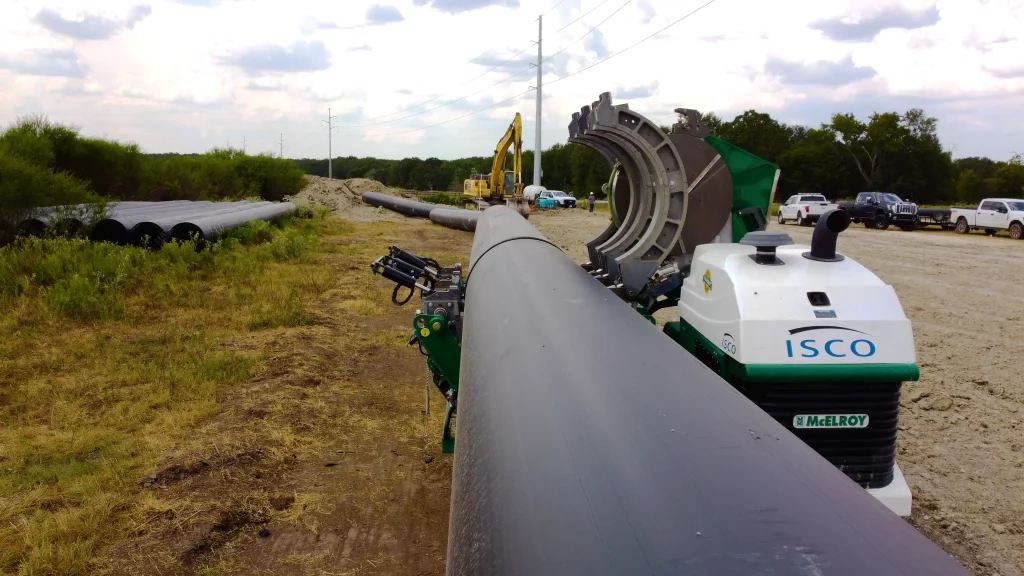
For rural water systems, HDPE pipe consistently delivers durability, leak resistance, and long-term cost stability required for critical transmission infrastructure.
Relationships that work recognize individual needs—and consistently meet or exceed them. The wrong match could mean years of consequences. In the piping world, it can mean decades of operational and financial strain.
Rural water systems operate under unique pressures: limited rate bases, long transmission distances, aging infrastructure, and environmental extremes. Every material decision must balance durability, cost, and long-term reliability, often with fewer resources and smaller crews than urban counterparts, especially on long rural water transmission pipelines where leak risk compounds over distance.
A rural water system checklist requires a prospective soul mate to check a few boxes.
The Economic Advantage of HDPE for Rural Water Systems
The cost of a piping system is a complex equation to get to the solution, but the solution is literally the bottom line.
While some of these bullet points begin to cross over with other checklists, they all explain how HDPE gives you a multi-pronged attack to make things easier on the wallet.
- Transport: due to the weight difference versus concrete, iron or steel, more pipe can be transported each trip.
Fewer trips reduce transportation expense and jobsite coordination. - Installation: those same legacy systems require cranes and heavy machinery to transport and place, while HDPE does not. There is also the possibility of trenchless installation, like horizontal directional drilling, which keeps the pipe moving forward without fittings or disruption.
Less equipment needs lower mobilization requirements and safety exposure. - Pipe length: sounds crazy, but it is much quicker to assemble a line with 40-foot lengths (HDPE) than 8-foot (RCP) or 20-foot (PVC, iron and steel).
Faster assembly shortens installation schedules and labor hours. - Joining: a quicker joining process with HDPE once again reduces time, and the pipes’ flexibility allows for a slight change in course without fittings.
Faster work reduces labor exposure and shortens overall project timelines. - Protection: HDPE has built-in chemical and corrosion resistance, so polyethylene sleeves or cathodic protection are unnecessary.
Eliminating additional corrosion protection steps simplifies installation and reduces long-term maintenance variables. - Maintenance and repair: properly installed HDPE is leak-proof. The aforementioned resistance also limits the need for inspection and repair as frequently as the legacy systems. IF there is a need for repair of an HDPE line, many solutions can be performed more quickly and at a lower cost without shutting down the entire system.
Reduced repair frequency lowers operational disruption and labor burden over time. - Efficiency: we mentioned leak-proof. Imagine you are transporting money through a pipe, and knew that all of it would arrive at its destination with one option, but some would be lost with others? No-brainer.
Protecting your commodity means more treated water reaches its destination—preserving revenue and rate stability. - Longevity: Properly designed and installed, HDPE systems are engineered for service lives that can exceed 100 years without needing to be replaced, and if the planning budget aligns with large diameter pipe, then expansion will not be necessary anytime soon. That sets forth a scenario where a system could conceivably not need any more financial burdens after the initial cost.
A longer design life supports stable long-term capital planning.
Durability in Harsh Soil and Environmental Conditions
The relationship metaphors end here.
Rural water lines must contend with harsh environmental conditions – like being buried in hot, volatile and shifting soils. HDPE’s chemical resistance and flexibility allow it to perform reliably in these harsh conditions. Even when an earthquake or rocky terrain makes for a change in course for a pipeline, HDPE rolls with the punches without compromising the integrity of the line.
In addition, it is not as though all lines live in a climate like San Diego. Just the opposite in most cases.
HDPE is built for temperature extremes as well as freeze-thaw cycles.
Leak-Free Reliability and Reduced Non-Revenue Water
A great partner in a relationship is always there, and you know what to expect. They will not let you down.
HDPE presents a leak-free path forward for your water lines. Unlike many legacy systems that account for planned leakage allowances, fused HDPE systems are designed to create a continuous, leak-resistant pipeline. For rural systems, where every gallon pumped represents cost, reducing non-revenue water is more than operational; it’s financial protection. Reliability intertwines with the final four bullet points above: monetary evidence, maintenance and repair, efficiency, and longevity.
Don’t find yourself with a partner you can’t trust.
Beyond the Pipe: Support Matters in Rural Water Projects
If you are fortunate, when you enter a relationship, your partner brings to the table not just their fantastic qualities, but a network of friends and family that can swoop in and help when needed.
Beyond the material itself, successful rural projects rely on experienced partners who understand planning, fabrication, field support, and long-term system performance.
Design assistance, material availability, including fittings and fabrication, field support and training, and guidance through each project phase all play a role in reducing risk.
It is not exclusively about the materials—it’s about who is standing behind it.
Whether in the world of amore or aqua, you need to find the right match or you face decades of consequences.
And rural water pipelines don’t allow for annulments.
Planning a rural water project?
Let’s explore HDPE solutions designed for long-term performance and leak-free reliability together.


Access our deep HDPE knowledge
field-reports
Innovative HDPE Solution for Maryland Landfill Water Collection
To protect Maryland’s water resources, the Resh Road Landfill partnered with ISCO Industries to install...

field-reports
Southern California Reservoir Inlet Pipe Project Encounters Tight Space
Faced with a 22-foot drop and a narrow 36-inch access hatch, NEWest Construction utilized the...

field-reports
ISCO Meets Dalton Utilities’ Needs for Wastewater Piping
By transitioning to high-density polyethylene (HDPE) for its gas, water, and wastewater systems, Dalton Utilities...
